Monday, June 9, 2014

Tucson

I lived in Tucson whilst doing a teaching exchange in 2003/04. This was a trip to get to spend some time with old friends, enjoy the city and the desert wilderness that surrounds it. Near the end of my trip I spent an evening addressing the Tucson Camera Club at the Jewish Community Center. This lively club were a great audience, challenged and inspired by my presentation and having many questions afterwards.

Being away from the norm was a great place to experiment with my new camera, a Pentax K-3. Having a 24.4 megapixel APS-C CMOS sensor, twice the size and yet the camera is smaller and lighter than my Olympus DSLR, I was drawn to the street photography I used to do last century, on film.


Photographic Workshops in Devon, Summer 2014

Introduction to digital photography - £50
A practical days workshop learning to gain control over your camera, shutter speeds, aperture, ISO, flash etc, setting it up for optimum quality under any given lighting, and making better pictures through composition. Numbers limited to a hand-full. I also offer it on a 1:1 basis for ½ a day for £75
Wednesday 18th June in Bideford (11am - 6pm) Click to reserve a place

Half Day Intro to digital photography - £25
A 'sit around the table' workshop to get to know your camera better. You'll learn about shutter speeds, aperture, ISO, flash and setting your camera up for optimum quality.
July date TBC Click to make an enquiry

SmartPhone Photography
- £25
A practical workshop to learn how to use your Smartphone's camera to take professional looking photographs and enhance those images on the go. Suitable for anyone with a SmartPhone. You will need to install a few cheap photo apps in advance which I'll advise on when booking!
Wednesday 25th June, Bideford (1.30 - 4pm) Click to reserve a place

Sea Caves, Shipwrecks and the Rocky Shore (10am - 5pm) - £50

An introduction to Dave Green's own photography. Spend a day with Dave experiencing the secret coast, hidden at the far ends of a sandy beach, full of caves and shipwrecks. Learn how to make the best of your own camera under demanding landscape and lighting.
Monday 16th June starting at Bude (11am - 5pm) Click to reserve a place
Family Photo Workshop - get to know your camera - £30 per adult (maximum 2 accompanied children free)
A practical workshop to get to know your camera better. You'll learn about shutter speeds, aperture, ISO, flash and setting your camera up for optimum quality.
July date TBC Click to make an enquiry

Photographing your own Artwork - £50
I have a wealth of knowledge and experience of photographing 2D artwork, jewellery and ceramics and I'm willing to pass this on to artists eager to improve their own image making camera skills. Although this workshop is for a small group (max 5) I also offer it on a 1:1 basis for ½ a day for £75, or I can deliver the workshop in your own home or studio anywhere in Devon for £100
Course Description pdf
Tuesday 17th June in Bideford (11am - 6pm) Click to reserve a place

Introduction to Photoshop (11am–6pm) - £75 with lunch, tea and coffee provided!
Opening an image file and adjusting levels, contrast, brightness and colour balance. Rotating, resizing and cropping an image. Placing an image or images into a new file. Using layers and history. Participants will need to be computer literate i.e. use a computer on regular basis and understand the basic controls. Small group (max 4). I also offer it on a 1:1 basis in your own home or studio anywhere in Devon for £175
July date TBC Click to make an enquiry

Monday, May 5, 2014

The Grand Canyon, Arizona

I've visited the Grand Canyon in the past, but this trip was after reading 'Grand Obsession: Harvey Butchart and the Exploration of Grand Canyon' twice! Butchart is the greatest hiker/canyoneer to have explored the Canyon and I saw it through different eyes this time and got all the way from the rim to the Colorado River.

The first two images here were from around 1000ft below the South Rim on the Hermit's Trail. This was an afternoon hike, 2000ft down the trail and back again, just to get acclimated to the terrain and altitude before the big hike planned for the following day. The Hermit's Trail is a lesser trod, unkept trail but feels similar to the kind of path you might find in winding through an olive grove on a Greek Island. The following day we (my wife Sadie and I) woke at 5am to catch the 6am 'hiker's bus' from Bright Angel Lodge to the trail head, a couple of miles away. Fortunately there was hot coffee and tea available from the hotel before the ride. The hike down the South Kaibab Trail is the shortest route to the Canyon floor, but it is also the steepest and this image will hopefully give you a sense of it's steepness. 
You get you first views of the mighty Colorado as you descend the trail and notice it's rich green colour. It used to run muddy brown before the dam at Glen Canyon. At the Canyon floor it's colour is even more saturated. The river here, at the part where the Bright Angel Trail leaves it looked very deep and flowed fast, it has the name Bright Angel Rapids but is not rapid enough to be listed in the Grand Canyon River Guide!
The trail back up the the rim takes you through the oasis of Indian Garden. This cottonwood tree is testament to year round ground water here.Near the top of Bright Angel Trail you need any break you can get from the relentless steep uphill climb. This view at Mile-and-a-Half Resthouse, 1000ft below the rim, was a welcome sight to enjoy. The trail was already in deep shadow when I got to photograph this view and fill-in flash was used with my camera held up-side-down to get the image held in my mind's eye.

Back at the South Rim for 6.15pm this is a challenging but very rewarding day hike. The Park doesn't recommend you do the whole of this in a day, but if you're reasonably fit and set off early enough, with water and snacks you can make it!


Thursday, April 24, 2014

The Mouse Hole, Mousehole, Cornwall

Finished constructed photograph of Mouse Hole 2014
I first got to know about the Mouse Hole Cave when researching the Beaford Old Archive in 2009 Looking for an image to use in an early Ghost Card for an exhibition I had been commissioned to make work for. I had known Mousehole, the village, pronounced ‘mowsull’ since childhood holidays in Cornwall; it had the quaint harbour and lots of cats. I had never questioned it’s name or come across the footpath which left the village on the giveaway Cave Lane. I discovered it for myself for the first time in June 2010. It had struck me as a man-made cave, some kind of mine, which hadn’t seen the sea for a number of years.

Francis Frith 1908
The old footpath sign carried a fitting scratched statement ‘Not To Beach’; and that had been all I needed to find this place. Its interior was very dry with evidence of youthful parties and a lush green fern covered entrance. I made some photographs with the intention of stitching them together in the winter, but those images stayed unstitched until now! Maybe I had felt at the time that the resulting image in my minds-eye wasn’t going to fit in with the sea cave images I was working on As well as the image in the Beaford Archive, collected by James Ravilious, I found that other photographers had documented it in the past. Francis Frith had been here in 1908 and 1927. I’m sure there were also Victorian and Edwardian photographers also making their way to this place when there was a metal ladder set in the cliff and the path was accessible without almost crawling through the undergrowth. 
Francis Frith 1908
Francis Frith 1927

This would have been a major attraction to the tourists back then and the trail from village to cave would have even been accessible to ladies and gentlemen in their flowing dresses and suits. My visit to the Mouse Hole in April 2014 was after a winter of record high rainfall and gale after gale coming in from the south west. This cave would have taken the full force of the weather fronts and huge waves. The storms had cleansed Mouse Hole from years of growth from land based plants and of the litter and detritus left from years of neglect from its visitors and from the high tides which had also left their mark. This was a profoundly different cave than the one seen four years earlier, but I expect this is a continual cycle, probably also witnessed by Frith and other returning pilgrims back then.
April is also a time for seabirds to nest and this time the entrance way was alive with kittiwakes leaving and returning to their precipitous homes. This with the blue sky was a major part of my memory of the cave in 2014, whereas the white overcast sky of 2010 had helped me concentrate on its tropical entrance. Time was against me as I was constricted to public transport to get me back from Penzance to St Ives, and this after the hike back into town; but sometimes this can focus the mind. The resulting image is a combination of iPhone and Olympus Pen. The image was quickly made with my iPhone including 17 frames of the entrance focusing of the kittiwakes in flight. The interior of the cave was then quickly made with the micro 4/3rds camera mounted on a tripod. Speed was also important here because the ceiling was continually dripping and it was only luck that all of the frames were made without a splat of water on the UV filter. Fortunately this cave is so large, tall and wide mouthed, that interior lighting was almost even, there being 1 stop exposure difference between the entrance and the ring of images deeper into the cavern. And only 2 stops difference from the outside exposure of sea, sky and birds.
Finished constructed photograph of Mouse Hole 2010
Post processing was started almost immediately with an iPhone image created in the AutoStich app; but it was clear from the start that it would be a difficult image to stitch. The iPhone frames were stitched together in Photoshop later in the day and a selection of the ‘bird’ frames were combined to reinforce my memory of the place. The camera frames were stitched a couple of days later and then the two formats were combined together to make a finished image that can be printed up to 1 metre squared.
With this new image I went in search of the folder containing all of the photographs from the Cornwall trip in 2010. These images made on my Olympus dslr were combined in a similar way and make an image of a similar size. But comparable in so many other ways which makes both images more interesting and a great record of this wonderful place.
Stitched iPhone images of Mouse Hole 2014

Saturday, January 18, 2014

Best of the Year 2013

One of the things I like best about a New Year is catching up on all of the things I missed in the previous year. I check in with NPR's 'All Songs Considered' and my head is usually filled with all of the critically acclaimed albums that passed me by. I keep an eye on the broadsheets for their pictures of the year and also keep up with technological advances. 
The greatest change in my own photography last year was the use of my iPhone to initially 'sketch' a photo out before making the real thing; and later to use it in the making of new images in a way I cannot work with my DSLR.

The photographic app I've used the most to progress my own work is AutoStitch (£1.50 Apple and Android). I started off using it to take, stitch and crop pictures to aid my 'seeing' of a space photographically; to give me an idea of how that place might look photographed. I then started using the ProCamera app (£2.99 Apple and Android) to take the photos, AutoStitch to Stitch in HQ and Photoshop Touch (£6.99 Apple and Android) to enhance and crop. 

So nothing that I couldn't do with my DSLR so far! But then I had a revelation - I found I was able to continually add and take away frames from my stitched image until I had achieved what I had in my 'mind's eye'. I was working on a set of images for an exhibition in Manteo, North Carolina, titled 'Café Culture'. These were to be photographs of the interiors of local cafés made entirely on my iPhone. Making the image above, of the Café Du Parc at the Burton Art Gallery, I was able to sit at a table shooting and stitching the scene, shooting more frames, deleting ones that didn't work so well, and doing this over and over until I was satisfied with the result. This was closer to the way an artist using paint would work and it was very satisfying to be able to complete the whole image from life.

So 2014, I've upgraded my phone and I've added a SmartPhone Camera Workshop to my list:

SmartPhone Photography - £25
A practical workshop to learn how to use your Smartphone's camera to take professional looking photographs and enhance those images on the go. Suitable for anyone with a SmartPhone. You will need to install a few cheap photo apps in advance which I'll advise on when booking!
Thursday 20th February in Barnstaple (10am - 12.30pm) Click to reserve a place


There's a new season of other workshops available too: http://www.greengallery.co.uk/workshops.htm 

Wednesday, December 18, 2013

Merry Christmas and a Happy New Year

I really wish anyone who might look at my blog the very best Christmas this year and hope that your hopes and dreams for 2014 might come true. These two images are of Bideford, North Devon, where I am based. I shall endeavour to post you some interesting and inspiring posts this coming year so please check back occasionally to see what I'm up to.
If you need instruction on how to use your camera better or even how to make the most out of an iPhone camera, PhotoShop, Photographing Artwork, Painting with Light etc please take a look at my Photographic Workshops at this link

Tuesday, September 10, 2013

Children's Photo Workshop

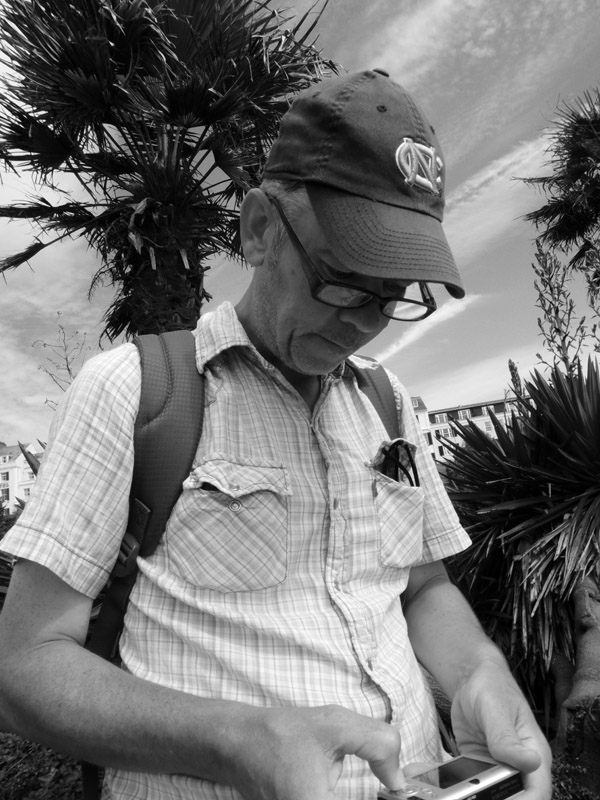
Dave Green, children's photo workshop by Ben
In the last week of the school holidays I led a couple of half day workshops for the children of Emma Bowler; two boys Archie aged 8 and Ben 6. Archie has a rare disability called Kniest Syndrome, like his mum, which means he'll never grow much taller than 4ft.

Archie wanted to enter the annual competition for disabled photographers 'On the Move 2013', and this years' theme is Travel & Leisure. I was very mindful of the competition, especially on our second meeting at Exmouth. The first workshop however was far more general, an introduction to the boys digital cameras. I got them to use the camera's automatic 'A' setting and to understand shutter speeds and aperture through experience of shooting under different lighting and focusing distance. This was done rather than teaching them to use the cameras manually as I often would with adults. They soon got the hang of '(shallow) depth of field' or as they called it "out in the field"; and of using the flower symbol for close-up, holding the camera steady and using a support under low light. The photo above, taken by Ben of me during the second part of the workshop in Exmouth, was a candid shot using the monochrome setting; thinking about the black and white images favoured by competition judge Giles Duley.

Duley is an award-winning and highly respected humanitarian photographer, who endured life-threatening injuries losing both legs and an arm when he stepped on an improvised explosive device whilst on patrol with the US Army in Afghanistan. I found him a great inspiration and incredibly interesting whilst researching him and his work prior to the workshops.

Both boys were very enthusiastic and made some terrific image. Best of luck to Archie with the competition. Hopefully I'll be able to publish a winning entry here!

Sunday, August 11, 2013

Westward Ho! and Bideford Art Society Summer Exhibition at the Burton Art Gallery 2013

Some text to accompany my work which is the first digital work the Society has show in it's 91 years:

Maiden’s Retreat, Marsland Mouth

I was interested in finding historical and literal context for some of the landscape I was experiencing, and went in search of a cave Charles Kingsley had written about as a sheltering place for Rose Salterne, his startled naked maiden in the novel Westward Ho!

In only one of these “mouths” is a landing for boats, made possible by a long sea-wall of rock, which protects it from the rollers of the Atlantic; and that mouth is Marsland, the abode of the White Witch, Lucy Passmore… “You be safe enough here to-night, miss. My old man is snoring sound abed, and there’s no other soul ever sets foot here o’ nights, except it be the mermaids now and then…There’s the looking-glass; now go, and dip your head three times, and mind you don’t look to land or sea before you’ve said the words, and looked upon the glass. Now, be quick, it’s just upon midnight.”

… Rose went faltering down the strip of sand, some twenty yards farther, and there slipping off her clothes, stood shivering and trembling for a moment before she entered the sea. She was between two walls of rock: that on her left hand, some twenty feet high, hid her in deepest shade; that on her right, though much lower, took the whole blaze of the midnight moon. Great festoons of live and purple sea-weed hung from it, shading dark cracks and crevices, fit haunts for all the goblins of the sea.                                                              

- extract from Westward Ho! by Charles Kingsley 1855

A cave was found but hardly big enough to find refuge and certainly wouldn’t hide your parts from the rest of the beach – was there another cave? Kingsley’s book was written over 150 years ago and it was set in Elizabethan times. Much can change at the edge of the land in just one year, let alone 150 or 400. My guess is that there would have been a far greater cave at Marsland Mouth in Kingsley’s day and the small, shallow cave wasn’t it. However one work of fiction can lead to another and I went about photographing the cave I had found but thought about the cave in his novel. 31 frames were shot for the construction of Maiden’s Retreat at 5.07pm over 7 minutes. Rather than using a long lens to prevent distortion and make my images as truthful as possible, as I would normally do, I used a wide-angle lens to distort the perspective and make the cave seem deeper. I was keen to highlight the heart shape of the aperture opening to illustrate the ‘love story’.

The frames were later stitched together in Photoshop.


Silver Mine, Combe Martin

Mining for silver, lead, copper, zinc, manganese and limestone has been done at Combe Martin since 1293. This place would have started as a cave, later it would have been mined, but now and for at least the last 100 years it has reverted back to being a cave. Combe Martin Bay is riddled with caves into the steep cliffs and the miners would have had to transport all of their tools and ladders across the rocky shore, in all weathers, every day at low water to work the mines. Then before they were cut off by the incoming tide, take their tools and any of the metals or stone mined back with them to the village.

This image was made to look as truthful as possible, an accurate record of the experience and memory of being in this cave, exploring all of it's nooks and crannies. 50 frames were shot and later stitched together to make this image. My images can often made up of more than 100 separate photographs, of different exposure, angle of view and framing, all from a fixed point to give the detail from the deepest blacks to the brightest highlights in this extremely high contrast scene. Photoshop is the computer programme of choice for the stitching of images together. This process can take many days to complete because the file size and processing power needed pushes the limits of today’s computer capabilities; but it is not unknown for me to rework an image a year or more later as software, processing power and RAM are updated.

Both constructed photographs are printed on archival paper, mounted on aluminium and protected by acrylic glass.