Wednesday, October 5, 2011

Graveyard of the Atlantic

Summer came at last to the South West of England, right at the end of September for 6 days. Fortunately it coincided with the autumn equinox which brought the best spring-tide of the year, and even more fortunately I had some time to make the most of it. I saw very little of the sun as I spent my time in achingly cramped positions, in small caves for hours on end, suffering for my art! I’ve had the title of my big show in North Carolina on my mind ‘Graveyard of the Atlantic’ a title both North Devon & Cornwall share with the coast of North Carolina. I was hoping to find some of the debris caused by the tail end of the last couple of hurricanes come tropical storms that came out of the west Atlantic, causing so much destruction and flooding on the NC coast and in Bideford’s twin town of Manteo on Roanoke Island where my show will be. A couple of very productive days were spent firstly at Combe Martin and Watermouth, then at Bedruthan Steps near Padstow.

To give my blog readers a taste of what’s coming and an insight into my practice I’ll describe how I took the frames which make the image above. This is just a quick thumbnail image, automatically made from very small copies of the originals, so that I can see, visually, that spending time on the photograph is worthwhile.

I was unfamiliar with Bedruthan so I took a while walking up, down and around the beach, or beaches, as there are many separated by headlands of jutting out rock. I was racing around because I wasn’t sure how long I would have at before I would be cut off by the tide and I wanted to get as much raw material in that time as I could. The cave would have been easy to get into if I’d been a 5 year old boy, so I needed to crouch right down and find a patch of wet sand to sit on near to the back. The thing that had really attracted me to this miniature world was the wall of frayed ropes and fishing net hung like a veil from a crack in the side of the cave. This had to feature prominently in my image and so I shifted around with my camera until I found the best composition taking into account rope wall, entrance shape, reflection of light etc. Taking no chances I packed a bigger kitbag than usual with 2 cameras and a couple of lenses. I ought to confess that I need to get my prime camera fixed as it has an auto-focus problem and there’s a speck of dust in the lens. So it was a case of going ‘old school’ literally manually focusing an old, but good quality, fixed focus 50mm f1.4 lens from my old Olympus SLR. That ought not to be difficult, but it was because there’s no ‘split-screen’ focusing on a DSLR and I couldn’t open and closed the aperture automatically, so it all had to be done, painstakingly, manually. I have to use the screen, rather than the viewfinder here, because it's so dark so my process each time my camera angle is adjusted is: open aperture manually on the lens, make shutter speed faster so that the image on the screen isn't way too bright, focus lens ring, close aperture down by 4 stops, slow shutter speed back down to where it was, fire the cable released shutter. Exposure was the same, labour, intensive manual process. With the camera firmly fixed to a tripod every frame was shot in RAW, using a cable release, with iso at it’s lowest (100), aperture closed down to f11, shutter speed was sometimes as slow as 8 seconds and many of the views, pieces from the whole, from this fixed point camera had to be shot many times with different exposure, points of focus and with various fingers, thumb and palm of the hand used to prevent flare coming into the lens from the light source directly in front of me; the mouth of the cave. I started photographing at 11:46am and at 12:08 had completed the 66 separate frames which will, fingers crossed, eventually make up one image. I had been intensely taking photographs for 22 minutes, add on the time it took to get into the hole, find the best place to set up my tripod, unpack the bag etc, I had been cramped inside for a good half hour and I could really feel my legs and the brightness of the sun when I emerged afterwards.
a contact sheet of all 66 images shot in 'Rope Wall' cave
Finding the subject matter and shooting the frames is just the start of a very long process. Each RAW file was then adjusted and saved as a HQ jpeg. A copy of these files was saved into a new folder and each of these was shrunk in dimension by 25% and saved as a lower quality jpeg. The image at the top was automatically generated through ‘photomerge’ in Photoshop CS5 from a selection of the frames that I shot to give me a thumbnail, a suggestion, of what the final image might look like. If I like what I have at this stage, and I do, I’ll take it on to a finished image; but this will take a good day’s work on the computer which can be saved for a cold, wet, winter day. It will, however give me a digital file that can be printed high quality to make an image as big as 2 metres high.

Tuesday, September 27, 2011

Ghost Story

I'm not sure if anyone was paying attention, I know I wasn't, when I posted the news about my Ghostcards exhibition at Walter Henry's in Bideford.
Last night I eagerly showed an old friend my new work saved to my phone; enlarging the image above I realised the ghost had disappeared. I had the wrong picture on my phone? or did ghosts really disappear? I put it down to me adding the wrong file to the slideshow, but then today, looking through the pdf download which accompanies the show I had the same ghostless image! Now, to date, there have been 103 people looking online or downloading this pdf, did anyone notice? I'm sure you're all too kind! So I had a look at my blog; the first picture - it was also ghostless here...And on the homepage of my greengallery website. Am I worrying too much?
Anyway, to make amends, here's 'the Rose of Torridge' with the ghost of Rose Saltern herself in the doorway, feeding the seagulls. It's a little bigger than the ghostless one so you'll now be able to see her (un)clearly.
As a footnote I should say that Ghostcards will remain at Walter Henry's until the end of October but has been relocated to the front window and the wall opposite the sales desk.

Wednesday, September 21, 2011

Workshop in Bude

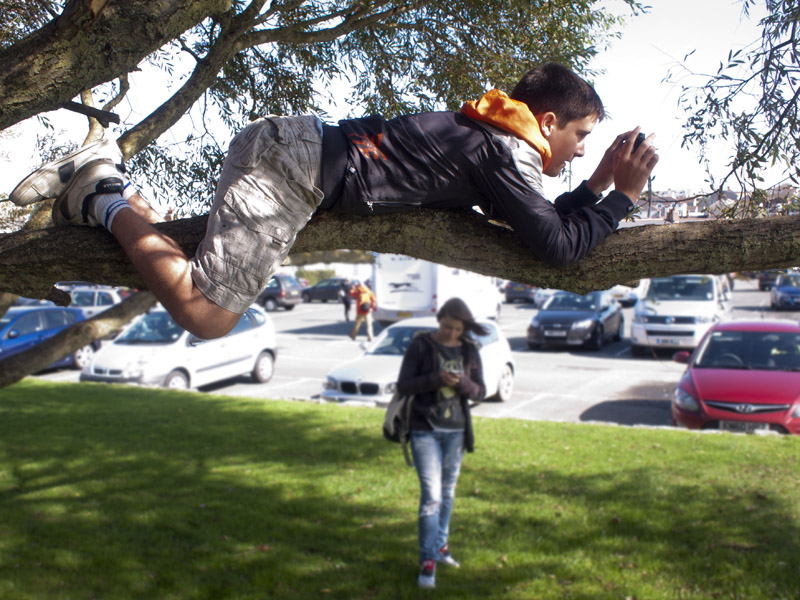
I spent today doing a workshop with some lovely students at Budehaven School in Cornwall. Just thought I should share their enthusiasm for photography in this post. After an hour and a half talking about mainly my work in caves on the North Devon coast and relating it to Ansel Adams who they'd been studying we took a walk down to the beach via the canal. Almost immediately they were on the floor, up trees, lying on their backs, finding weird and wonderful camera angles and really seeing their surroundings in a new light. These are a few examples of how they were working.

Thursday, September 1, 2011

Ghostcards ..... and new workshop details

Ghostcards is at Walter Henry's Bookshop in Bideford, Devon, part of Bideford Bay Creatives 'Culture Show', throughout September and October 2011.

Throughout Dave Green’s art practice, presentation has been very important. Mounting has always been clean off-white, museum grade, archival, double thick board cut with a neat 45 degree aperture. Frames which used to be hand made, out of high quality hardwood, are now generally shop bought but made of solid oak. There’s an old adage that if you use the right materials to present your work they complement and do not distract from the image. This new body of work however is a big departure from the norm.

The ‘Ghostcards’, a label coined by Mercer University professor of history Dr Erik Klingelhofer on seeing this work, are multi-layered artworks where not only the image but the frame and mounting reflect a fluid state of both past and present. This work is no longer a two dimensional picture which can be reproduced at infinitum, it has three dimensions when we include the often, oak Victorian frame with guilt inset, and one could argue that they have a fourth dimension as a sense of physically looking back through time is also evident in all of the work.

This work originated two years ago through a commission from Beaford Arts to make a new piece of work from an image in the Beaford Old Archive. This piece was ‘Still on the Beach, Appledore’. A month later another image was added ‘Greenwarren House’, this time made as part of a photographic residential at Beaford Arts which is based in Greenwarren House. These two images already show elements common through Dave’s other work, stitching photographic frames together to produce a combination print, time exposure, painting with light and added a new one, the work of another photographer responsible for the inspiration for the new image and for the original ‘ghost’ image held within it.

June 2011 saw more images realised as part of the Bideford/Manteo Postcard Exchange shown at the Burton Art Gallery. Beaford Arts again generously helped with the free use of some of their Old Archive images. The current show is the first to use the antique frames Dave has been collecting over the past year. Ilfracombe Harbour epitomises the use of the Victorian frame as this particular frame held the original black and white image which inspired this piece.

Free pdf download to accompany Ghostcards: www.greengallery.co.uk/ghostcards.pdf
For larger images go to: www.bbcdevon.org It may take a while to load!

Photographic Workshops in Devon, Autumn 2011

Introduction to digital photography 10am - 5pm - £50
A practical days workshop learning to gain control over your camera, shutter speeds, aperture, ISO, flash etc, setting it up for optimum quality under any given lighting, and making better pictures through composition.

Tuesday 27th September in Bideford
Saturday 1st October in Barnstaple
Thursday 6th October in Exeter
Tuesday 11th October in Torrington
Saturday 15th October in Tavistock
Tuesday 25th October in Bideford
Friday 28th October in Exeter
Thursday 17th November in South Molton
Saturday 19th November in Bideford

Photographing your own Artwork – 10am – 5pm - £50
There has been a lot of demand for this workshop on ‘Photographing your artwork' over the summer. I have a wealth of knowledge and experience of photographing 2D artwork, jewellery and ceramics and I’m willing to pass this on to artists eager to improve their own image making camera skills. Although this workshop is for a small group (max 5) I also offer it on a 1:1 basis for ½ a day for the same price.

Saturday 29th October in Bideford
Tuesday 22nd November in Bideford ... more dates to follow!

Painting with Light - An evening workshop celebrating the dark nights of the Winter. You'll learn how to make 'long exposure' photographs using coloured lights, flames, sparklers and hand-held flash.

Thursday November 10th Northam Burrows 6pm-9.30pm - £25 … more to follow!

Special: Intro to Digital/Painting with Light - An afternoon into evening workshop celebrating the dark nights of the Winter. A practical workshop learning to gain control over your camera, shutter speeds, aperture, ISO, flash etc, setting it up for optimum quality under any given lighting, and making better pictures through composition. This is combined with photographing under low light where you'll learn how to make 'long exposure' photographs using coloured lights, flames, sparklers and hand-held flash.

Saturday December 10th at Westward Ho! 2pm-9pm - £50

Introduction to Photoshop - Participants will need to be computer literate i.e. use a computer on regular basis and understand the basic controls. Small group (max 4).

Thursday 3rd November, 10am – 5pm - £50

Workshop gift vouchers are always available for that special present and with this in mind I'll be offering some workshops after Christmas for those people with new cameras so that they'll get to know them better!

More workshops will be added later, please let me know by email if there’s a photographic workshop you would like that I don’t offer at the moment and if there’s a location that I don’t offer.

Tuesday, August 16, 2011

Detritus


I’m sometimes blinded into thinking that our beaches are relatively clean. The places I go are exposed to such a punishing surf that little detritus is left. Sometimes there’s a fishing float, tyre or rusting side of a ship lodged permanently into the back wall of a cave but the rocky shoreline can appear scoured clean with every tide. Westward Ho!, my local sandy beach also fools you into thinking that litter is a thing of the past. That is until you see it at the end of a summers day after the holidaymakers have gone. On-shore-drift makes a fine job of moving the crisp packets, beer cans, and discarded beach toys down to Saunton Sands and the fortnightly spring high tide makes a good job of finding the neatly hidden plastic bags and polystyrene cups pushed into holes on the pebble ridge or held under a stone. We’ve learnt to recycle so well now that we even crush up the water containers so they take up less space. I’ve even heard visitors ask why there are no bins on the beach having no comprehension that at high tide there is no beach; but this doesn’t stop piles of rubbish being neatly stacked together as if to say “We believe this would make a good place for a bin!”

How difficult is it "take your rubbish home with you"? Another question would be "Is anyone ever prosecuted for dropping litter?” I’m sure we could find a few cases but how about “Has anyone ever been prosecuted for letting a helium balloon fly off, or a lantern for that matter?” I will end up on a beach eventually.
At least this cream bottle served a purpose as a useful floating home. I threw it back into the sea so hopefully these goose barnacles survived!

Wednesday, August 3, 2011

Song of the Surf

I went home to visit my parents recently and I was reminded of an image that has been with my since as far back as I can remember. It’s a print of a painting called ‘Song of the Surf’ by Ed Mandon. I expect it was a popular print in its day, that being the early 1960’s. I remember often looking into this picture of the sea. Not the pretty turquoise blue of Cornwall or Greece, or the palm tree lined sun bleached cove, the peaceful relaxing sunset or the family snapshot of children paddling in the shallows; no this was Mandon’s deep green sea, wild and free, the waves endlessly crashing in my mind, a vast living breathing entity. The sky, a cold yellow with the threat of rain. It’s a picture that has influenced my subconsciously for a long time. I remember once on Marconi Beach, Cape Cod, I ran down the beach towards the sea and the waves as the holidaymakers ran in the opposite direction, fleeing (as if for their lives) as huge thunderclouds gathered over the ocean.

I’m a lot closer to that deep green wild enticing sea now living in North Devon. And getting closer to it in my own work. ‘Song of the Sea’, it certainly calls you; maybe that’s the point, maybe it’s song and call is at its loudest when the sea is in its foulest mood and perhaps that is why the coast here is the ‘Graveyard of the Atlantic’.

Sunday, July 17, 2011

Adventures on an Ocean Kayak

Inspired by a day I spent last year photographing Sarah Adams for the catalogue to her show at the Maas Gallery in Cork St, London, I promised myself that in 2011 I would get a kayak so that I would be able to experience and photograph the North Devon coast at high tide and access places impossible for me to walk to at low tide. I’ve done a little rowing before as I had a small wooden boat moored on the mud banks of the Torridge minutes from my house; and I’d done a bit of kayaking in Manteo, North Carolina in Mayor Jamie Daniels double sit-on kayak. But it was the thrilling experience of paddling out to sea in preparation for and on the day of the shoot with Sarah that really excited me about the possibilities.

I bought an bright yellow Osprey sit-on Kayak just over a month ago and have been taking it down to the ‘East-the-Water’ boat ramp as often as possible. This access to the river is minutes from my house and is made swiftly on a shopping trolley conversion. Paddling up and down the river with and against the tide is relatively easy but good for building up experience and body strength. Kayaking in the sea is a different matter entirely.

The first time I tried paddling through the surf I got thrown out of the kayak all the time, especially when paddling into shore with the waves behind me; it was the equivalent of a bucking bronco whose only intent was to have me thrown off into the water. With more experience this got better but I think a good rule here is: if the sea is good for surfers then it’s bad for kayaking!


My first ocean kayak with intent to make some pictures was a couple of weeks ago at Combe Martin. The sun shone and the sea seemed quite calm, just after high tide, with the waves crashing close to the shore. I wore a wetsuit, lifejacket and a pair of old Keens; my camera and tripod were packed into a dry sack with a towel and strapped to the rear of the kayak, I attached my self and the paddle to the kayak too. I was all set to paddle off, sat in the kayak in the seas shallows, adjusting my back support I took my eyes off the surf for a split second and I was rolled over with no apology. I took this as a warning that you can’t relax for a moment, even in small surf as it will throw the kayak over any chance it gets. I got back in, ignoring the comfort and support of the seat back and paddled with all my strength straight at and through the waves at a right angle to the shoreline; not slowing down or taking my eyes of the surf until I was passed them in the relative calm of the undulating waves.

Giving a small promontory of rocks a wide berth I traversed to the right until from out at sea I was looking into the mouth of a cave I had called ‘Silver Mine, Combe Martin’ on a previous photo trip on a low spring tide. I could see that the back of the cave was clear of the receding tide although it’s entrance had a thick wall of surf. This was what I wanted, what I had seen in my mind’s eye, so with little hesitation I paddled as fast as I was able in a straight line for the mouth of the cave. I hit the pebbly shore at speed leaning right back to help the kayak ride as far into the cave as possible. I climbed out quickly and dragged the kayak to the back of the cave.

The view from here was awesome. All of my senses felt heightened as I observed this familiar cave’s entrance being pounded by the surf and sunshine shining through it from behind. Sometimes with a big wave the walls of the cave would slightly darken, then for a split second, was bathed in an incredible refracted, diffused light as the wave eclipsed the sun.

I dried my hands on the still dry towel and set up my carbon-fibre tripod in the shallow water, attached my camera and made a series of images, exposing the dark inside walls of the cave for a lot longer than the mouth and the incoming breaking waves.

This sketch (above) is the first of I hope many images that I’m hoping to get to make along the North Devon and Cornwall coast at high tide. It’s made from a selection of 60 original frames, and is far from perfect in it’s present state, but I wanted you to see a direction that I’m heading as I’m really pleased with the power and fury of the surf and the way it gives a sublime beauty this coastal landscape. Below is the second sketch image of the cave next-door which I refer to as 'Lead Mine, Combe Martin'.
All I had to do then was to get back to the beach at Combe Martin…..