Sunday, January 30, 2011

From Source to Sea

There is much demand for photographic workshops in 2011. This week has seen me at Budehaven School in Bude, Cornwall introducing digital photography to some 15/16 year olds, including being interviewed by them. They were a tremendous bunch of students spending 2 hours on the bitterly cold beach making some very good pictures of the natural and man-made landscape.

Clockwise, 1st & 3rd by Colin Rowland, 2nd Frank Whitehead.

Then at the weekend I had similar weather for a workshop ‘Making the Most of your Digital Camera’ at the Burton Art Gallery and Museum in Bideford. This was based or inspired by an exhibition of the watercolourist Shelia Hutchinson whose exhibition ‘From Source to Sea’, first shown in 1951, was in the gallery. The wonderful image above of Bideford and its historic longbridge is from the exhibition. Unlike Hutchinson who took the train, cycled and hiked the length and breadth of the Torridge Valley in the late 1940’s with painting gear in her backpack; we were restricted to just over 1 hour’s time photographing Bideford’s quay, river, bridge and quaint streets. The morning was dedicated to understanding the digital camera, shutter speeds, aperture, ISO, file size, exposure etc then after lunch the photographs were made. It was an exhilarating day, it was amazing how much was learned the proof of which was in the prints, 2 each, the participants made and exhibited in the Burton’s Gallery, by the end of the afternoon. The images will be on show until 4th February.
Workshop photographers: Janet Millen, Ian Penrose, Colin Rowland, Norman Tuck and Frank Whitehead

Tuesday, January 25, 2011

Turning Night into Day

On January's full moon, Mike Bentley and I went down to Clovelly and onto Black Church Rock at Mill Mouth. The night was unbelievably clear with a huge, bright, full moon. We'd brought torches with us but hardly needed to use them. Walking down the track at 9pm was an eerie experience as, without warning, roosting pheasants would fly, startled, out of trees and old misshaped oaks would spread contorted shadows over the path ahead. At one stage we had to traverse a fallen tree, it's trunks width being equal to our height.

The forest had managed to keep the frost at bay but as we got onto the beach the pebbles were suddenly very slippy. Moving down the beach, ice soon turned to water and still further to dry stone thanks to the breeze. Travelling over a rocky shore is always dangerous and I wouldn't recommend trying it at night to anyone, the harsh moon light confuses any spacial awareness, the shadows blacker than black.

Black Church Rock was magnificent in this dream world, our photographs describe the colour far better than the rods in our eyes. The landscape format picture above is of me taking the portrait format, by Mike Bentley. I believed I could see well in this light but to give you an idea of the amount of light the photograph above was 400iso, f2.8 and 1 minute exposure; the limits of my camera without my (broken) cable release. It's noticeable from the image that the horizon isn't straight - seeing to compose is so difficult and focusing complete guesswork. Even focusing with torchlight or with the camera flash is impossible with this dark rock.The colour in these pictures is amazing though. The reflected daylight and harsh shadow is evocative of a hot, bright, summers day. However the addition of a coloured light in the above photograph and the stars in the sky do much to question this assumption.
Tuesday, January 18, 2011

Royal West of England Academy


I have had two photographs selected for
The Open Photography Exhibition at The Royal West of England Academy in Bristol. They have been selected from 1700 entries from across the South West. The Exhibition opens on the 20th February and runs until 5th April.

Wednesday, January 5, 2011

New Year's Resolution

Every year I always make an image of some sort for a Christmas card. Sometimes it’s a physical card, sometimes an ecard, sometimes an animated gif; but these have never appeared on my blog.

Therefore my New Year’s resolution is to make a post of my Christmas image for the record and so that anyone viewing this blog who hasn’t received a Seasonal Greeting from me may get one. This image, taken during the switching on of the Christmas lights in Bideford was an experiment with Photoshop CS5’s HDR capability. Rather than combining images with a range of exposure, I combined a variety of the same exposure but with different parts of a laser show, people in different places and all of this at a slow exposure which blurs a lot of the movement. It isn’t a straight HDR either because that combined image was then merged with a couple of others taken from the same place, and some of these were made through intentionally adding some movement to the camera mid-way through an exposure. I’m really pleased with the result because it makes a very disappointing display, from a spectator's point of view standing in torrential rain, into a real light spectacular.


Wednesday, November 10, 2010

Condemned

It’s been a while since my last post. Most of September and the whole of October were spent in the States, accompanying Sadie Green on her Winston Churchill Travel Award www.sadie-green.blogspot.com where I documented her journey of discovery tracing the export of North Devon pottery from the 17th and 18th centuries. I was also representing Bideford Bay Creatives www.bbcdevon.org in Manteo NC supported in part by a Networking Artists Network go-and-see award; developing a relationship between Bideford and her twin town Manteo through the arts. Whilst there I was posting to the www.bidefordmanteo.blogspot.com


One of the similarities of both towns is their geographic settings as naturally sheltered harbours. Bideford 3 miles up from the Atlantic Ocean on the tidal River Torridge and Manteo on an island in the shallow Roanoke Sound 5 miles west from the thin, fragile, Outer Banks spit than shields it from the other end of the Atlantic Ocean. My photographic work in North Devon has been primarily in the sea caves along the rocky shoreline. The Outer Banks of North Carolina is 100 miles+ of sand, called, like our North Devon coast “The Graveyard of the Atlantic”. Both places have this unenviable title because of the 100s of wrecked ships on NC’s treacherous sand bars and our rocky reefs.


Global Warming, Climate Change and Sea Level Rise with the expected greater frequency and magnitude of storms will only add to the graveyard. The irony is that it makes great pictures. Whilst in North Carolina I spent many a late afternoon walking the Atlantic beaches and the closest to Manteo's was at Nags Head; here wooden houses, now condemned for living, seem to have been built on the beach. Whether this is a sign of climate change or of Man’s stupidity or both is unclear, but as is often the case with buildings they look their best just before they die.

A note on the photographs: The last 2 images in this post were taken by the light of a full moon and distant street lighting. Exposures were 1 minute long.

Thursday, August 5, 2010

Pinhole Workshops

There seems to be a lot of demand for Pinhole Workshops this year, either that or I'm in greater demand, either way is good. I've just completed a days workshop at the Dartmoor Life Museum in Okehampton, a wonderful place full of nooks and crannies where you discover treasures of the past.

The miracle of photography is experienced in its most heightened form through a pinhole workshop. I’ll never understand how I completed a National Diploma in Graphic Design and a HND in Photography without being taught about the pinhole camera. It wasn’t until I started teaching full-time myself that I learned about this subject. The amazing thing is, as my 7 students learned yesterday, that you start the day with a shoebox or biscuit tin and after about an hour using only black card, scissors, tape, a square of black plastic and a pin, you can make a usable camera.
Guessing the exposure takes a little longer (unless you do some complex maths), because every camera (or box in this case) has a different size, or distance from the pinhole to the paper negative (traditional photo paper). Fortunately, with everyone using the same pin, the ‘lens’ diameter is the same. Considering that the only adjustment to exposure was time, 3 of the 9 cameras made in the workshop made acceptable paper negatives at the first shoot. After another couple of tries everyone had a good exposure. Keeping the cameras still, through exposures of between 1 and 8 minutes with a little wind around, proved to be the next challenge. And the final challenge was getting an interesting image. The image below is a pinhole photo of her mum by a 5 year old called Ophelia and has the quality of Julia Margaret Cameron.

My next pinhole workshop is on Saturday 4th September at the Plough Arts Centre in Torrington and is for anyone over 14. Please get in touch with the Plough to book a place.

Wednesday, June 16, 2010

Back Photographing Bands

Peter Bruntnell our local North Devon singer/songwriter, who tours with his band nationally and internationally, is responsible for organising and mc-ing Monday nights at Lilico's in Barnstaple, part of the North Devon Festival through June. He'd asked me if I'd take some pictures, here are some of them. Pete's the one with the blue head.
Photographing musicians is always an interest of mine, especially in this type of intimate venue. Here I was essentially sharing the stage with the band, trying my best not to stand on the guitar leads, occasionally adjusting the levels on the mixing desk when prompted.
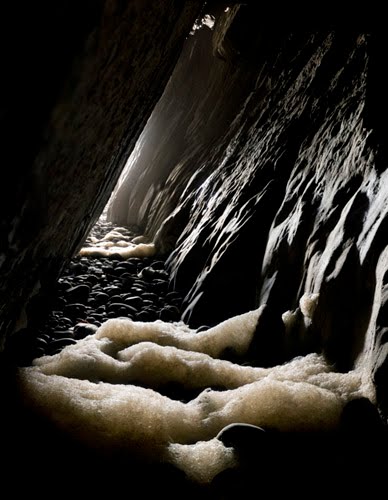
There's a similarity here with my cave pictures. I'm usually in a cramped uncomfortable position, I tend to shoot into the light which is extremely high contrast and the light level is very low compared with daylight. Unlike a cave where I can use a tripod and shoot at 1 second and 100 iso, here I'm restricted to in excess of 800 iso and shutter speeds between 1/15 and 1/30 sec, hoping to allow some movement but keep a sharp, clear, facial expression when the opportunity arises.