 It’s been a while since my last post. Most of September and the whole of October were spent in the States, accompanying Sadie Green on her Winston Churchill Travel Award www.sadie-green.blogspot.com where I documented her journey of discovery tracing the export of North Devon pottery from the 17th and 18th centuries. I was also representing Bideford Bay Creatives www.bbcdevon.org in Manteo NC supported in part by a Networking Artists Network go-and-see award; developing a relationship between Bideford and her twin town Manteo through the arts. Whilst there I was posting to the www.bidefordmanteo.blogspot.com
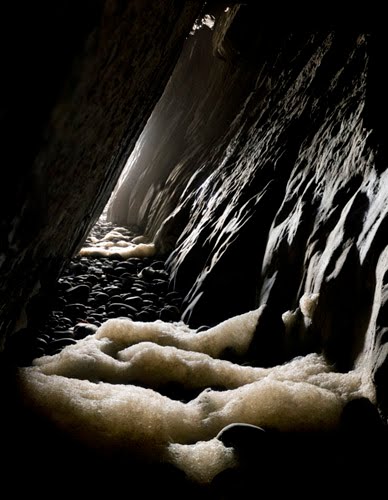
 One of the similarities of both towns is their geographic settings as naturally sheltered harbours. Bideford 3 miles up from the Atlantic Ocean on the tidal River Torridge and Manteo on an island in the shallow Roanoke Sound 5 miles west from the thin, fragile, Outer Banks spit than shields it from the other end of the Atlantic Ocean. My photographic work in North Devon has been primarily in the sea caves along the rocky shoreline. The Outer Banks of North Carolina is 100 miles+ of sand, called, like our North Devon coast “The Graveyard of the Atlantic”. Both places have this unenviable title because of the 100s of wrecked ships on NC’s treacherous sand bars and our rocky reefs.
 Global Warming, Climate Change and Sea Level Rise with the expected greater frequency and magnitude of storms will only add to the graveyard. The irony is that it makes great pictures. Whilst in North Carolina I spent many a late afternoon walking the Atlantic beaches and the closest to Manteo's was at Nags Head; here wooden houses, now condemned for living, seem to have been built on the beach. Whether this is a sign of climate change or of Man’s stupidity or both is unclear, but as is often the case with buildings they look their best just before they die.
A note on the photographs: The last 2 images in this post were taken by the light of a full moon and distant street lighting. Exposures were 1 minute long.



 Close by is the studio of Doug Fitch, another young potter with a huge respect for the local tradition who even sources local clay which he digs out. Doug also has a collection of old pots and shards from the time when pottery in this area was as big an industry as it was in Staffordshire. The images in this post are the start of the documentary which I intent to take with me to


